AP Report: EU Naval Mission Faces Surge in Gulf of Aden Piracy
A return to the sea by Somali and Yemeni pirates threatens 12% of global trade as regional conflicts destabilize shipping lanes.
By Ethan Cooper ·
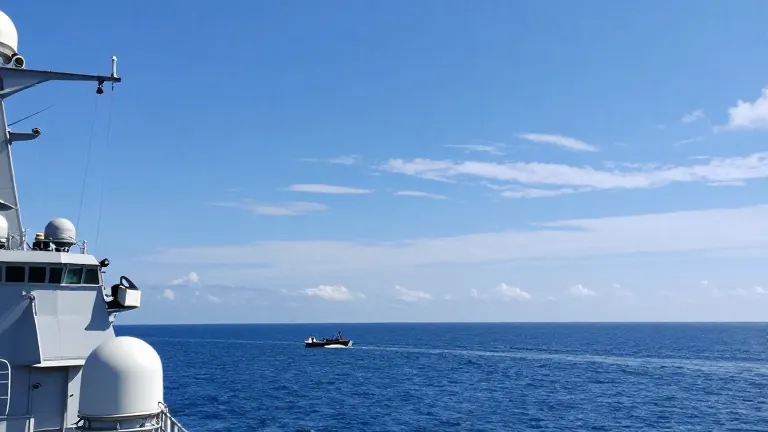
The air on the Spanish frigate ESPS Santa Maria was thick with the smell of gunpowder and salt.
In the Gulf of Aden, four Spanish special forces soldiers stood in a line, wearing sunglasses, face wraps, and body armor. A petty officer shouted, "Fuego!" as the soldiers took turns firing clips from pistols and machine guns at targets marked with human organ shapes. The drill was a rehearsal for the real threat: pirates seizing cargo vessels in the waters near the Bab el-Mandeb Strait.
The Bab el-Mandeb is a narrow chokepoint, less than 30 kilometers wide, that serves as a critical artery for global commerce. In peacetime, roughly 12% of the world's trade, including one quarter of all container traffic, passes through this route between Asia and Europe. That percentage has grown in importance recently because the Strait of Hormuz has been severely disrupted by the conflict involving Iran.
Piracy in the region has climbed sharply. Since the Houthis began attacking shipping in November 2023, there have been 79 pirate attacks in the area. Portuguese Commodore José Rodrigues Pedra, the commander of the Atalanta mission at sea, noted that about 30 of those attacks occurred after the outbreak of the Iran war in February. "I am not saying that there is a direct link with this crisis, but what I can say is that crisis creates crisis," Pedra said from his cabin.
The European Union's Operation Atalanta, established in 2008, leads the maritime security effort in the western Indian Ocean and the Gulf of Aden. The Santa Maria, a 4,000-ton warship that is 40 years old, hosts more than 200 crew members. The vessel is equipped with heavy-caliber guns, artillery, torpedoes, and missiles. A helicopter and a drone launch regularly from the stern to scan for threats. Cmdr. Fernando María Zumalacarregui Alario, the ship's commanding officer, warned that threats to cargo ships directly impact Western economies. "If it is in danger.. the prices are going to rise, and our life is going to be much worse," he said from the bridge.
The resurgence of piracy is driven by economic hardship in Somalia and the Horn of Africa. The U.N. reported in February that around 30% of the population in the region faces critical levels of food insecurity. Pirates based in Puntland, a semiautonomous region of Somalia, have seized fuel tankers and a Turkish ship carrying weapons. A new tactic involves pirates attacking off the Yemeni coast and then towing ships toward Somalia to exploit the chaos.
The Associated Press has tracked six commercial vessels hijacked between April and August of this year. Five were freed, but the MT Asana, a Tanzanian-flagged tanker captured in July, remained under pirate control in Somali territorial waters as of an Oct. 16 update. The International Maritime Organization stated that 22 seafarers were still captive on that ship. In September, five crew members died during the operation to recover the tanker Honour 25, which had been held since April. The IMO said 44 seafarers were freed from that vessel and two other tankers, the Eureka and the Sibu 1.
Analysts say the instability created by wars in Yemen, the Horn of Africa, and Iran is pushing people to the sea. Jakob Larsen, safety and security chief for the shipowners association BIMCO, noted that fuel prices have risen due to the Iran war, compelling people to seek new livelihoods. "Piracy is one such way," Larsen said. Christopher Hockey, a fellow at the Royal United Services Institute, added that the disruption suits the Houthis and Iranians. He warned that shipping lanes may soon divide between vessels with armed guards and those without. "No vessel has ever been hijacked with an armed security team on board," Hockey said.
The EU mission also operates a surveillance plane from a French military base in Djibouti. This plane uses radar and cameras to monitor the waters. The data is shared with military deployments from the United States, South Korea, Japan, India, and other European nations. While the mission helps thwart attacks, commanders say the success is often measured by the withdrawal of would-be pirates upon seeing a drone or ship. Shipping companies are responding by rerouting vessels and paying higher insurance costs. Mohammed al-Basha, founder of the Basha Report risk advisory firm, said the Houthis have approached some companies to offer protection services for the strait. "They’re like, ‘OK, so Suez Canal is making six billion a year.. And so how do we make money from that?’" al-Basha said.