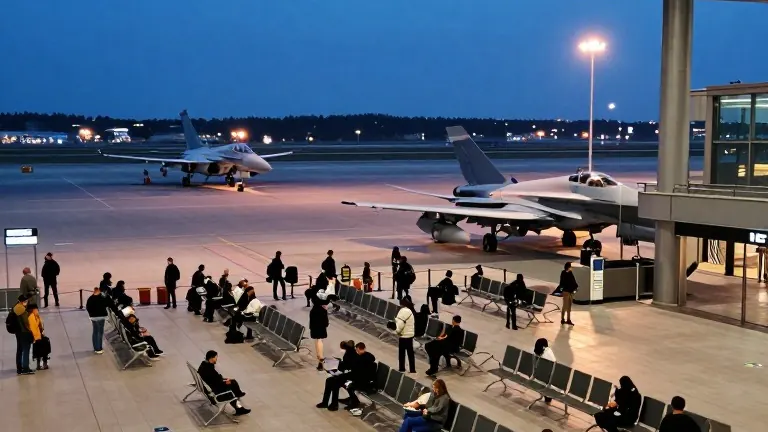
Fighter jets escort 14 flights after new wave of European bomb threats
Authorities in Prague, Paris, and Dublin responded to a surge in hoaxes that left no one injured but disrupted operations across the continent.
By Jenna Mitchell ·
Fourteen flights faced bomb threats on Thursday, accounting for just 0.05% of the nearly 26,300 aircraft movements across the European network that day. Despite the low percentage, the volume of hoaxes has intensified, with officials reporting seven additional threats on Tuesday and eleven more on Friday. The European air traffic authority, Eurocontrol, confirmed it was monitoring the situation closely to mitigate any further disruption to air traffic flows.
The threats have prompted immediate military and police responses in several countries. In Hungary, Defense Minister Romulusz Ruszin-Szendi stated that fighter jets escorted three passenger planes through the country's airspace on Friday. The jets protected flights traveling from Brussels to Sofia, and from Prague to Cyprus and Romania. In France, four aircraft received similar alerts. These planes landed safely at Paris Orly Airport, where bomb disposal experts conducted inspections after the threats were issued.
Prague has become a focal point for the security operations. Nine of the affected flights involved Václav Havel Airport, according to spokesperson Denisa Hejtmánková. The impacted routes included connections to and from Denmark, Spain, Britain, the Netherlands, Cyprus, Italy, and Romania. Czech police noted that the security measures taken at the airport had a minimal impact on normal operations, although a WizzAir flight from Prague to Rome was diverted to Venice, resulting in the evacuation of all passengers.
Security experts are preparing for a coordinated response. Apostolos Tzitzikostas, the European Union's transportation commissioner, met with Eurocontrol and the EU's Aviation Safety Agency in Brussels on Friday. He announced that a group of security specialists will convene in the Belgian capital the following week to discuss necessary measures. Tzitzikostas emphasized that the priority is ensuring the safety of passengers and the smooth functioning of European aviation.
The threats have expanded beyond the aviation sector to include major media organizations. In Ireland, the Dublin headquarters of national broadcaster RTE was evacuated on Friday after receiving a bomb threat. Live broadcasts were replaced with prerecorded programming until police with sniffer dogs cleared the building. Irish Prime Minister Micheál Martin described the incidents as evidence of how simple it can be to cause disruption through unconventional activities designed to cause fear.
Other broadcasters also reported receiving alerts. U.K.-based Sky News stated it received a security threat but remained on air while working closely with authorities. In Bulgaria, NOVA TV said it received an email on Friday claiming the sender was behind the European air traffic threats. The broadcaster implemented standard safety measures without interrupting its TV and radio broadcasts.
Authorities have not yet identified the group or state actor responsible for the wave of hoaxes. An email sent to airport authorities in Rome on Thursday purported to come from an anti-feminist group targeting a feminist regime. Another European airport received a threat with similar wording, though it is unclear if the same sender was involved. The timing coincides with warnings that Russia may be ramping up hybrid threats in Europe.
Robert Jordan, research director at Britain's Royal United Services Institute, noted that secure messaging apps have increased the anonymity of those making threats. He explained that airline risk appetite remains incredibly low because the industry is ultimately responsible for passenger lives. Paul Reuter, vice president of the European Cockpit Association, said crews are prepared to respond professionally, often carrying extra fuel and identifying potential diversion airports when alerts are received.