Florida Elections Officials Clarify Role of Immigration Agents at Polling Sites
Local supervisors report that federal agents spotted near early voting locations were simply casting ballots, not conducting coordinated enforcement operations.
By Jenna Mitchell ·
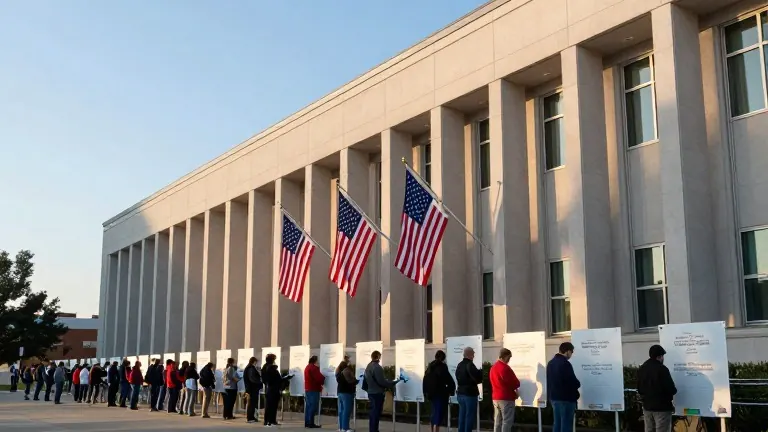
Leon County Supervisor of Elections Mark Earley confirmed that U.S. Customs and Border Protection vehicles seen outside an early voting site in Tallahassee last week were there to cast ballots, not to enforce immigration laws. Earley stated that he contacted the Federal Bureau of Investigation after the initial reports emerged. The agency's investigation indicated that the agents were in Tallahassee before they were scheduled to be deployed out of Florida. Earley noted that these individuals were not expected to be present in the state on Election Day itself.
The discovery provides a specific explanation for one of the high-profile incidents that have circulated during Florida's early voting period. In a separate case in Key Largo, masked agents reportedly conducted an operation near a polling site. The Monroe County Supervisor of Elections has just completed an investigation into that specific occurrence. These events have fueled speculation across the state regarding a potential coordinated effort by federal immigration enforcement to influence voter behavior. However, local elections officials and fact-checkers maintain that no such systematic campaign exists.
Earley argued that the anxiety surrounding these sightings could have been reduced if federal officials had clearly communicated their presence from the beginning. He criticized the administration's vague responses, describing them as "maybe" answers that left local officials scrambling to reassure the public. He said the behind-the-scenes messaging suggested there would be no coordinated presence at the polls, a stance that contrasts with the visual evidence that has reached the public.
Amy Sherman, a senior correspondent for PolitiFact, assessed the logistical feasibility of a large-scale immigration enforcement operation at polling places as "highly, highly unlikely." She pointed to the numbers to support this view, noting that Florida has approximately 100,000 voting sites. Sherman argued that the total number of Immigration and Customs Enforcement agents does not come close to that figure. She also cited federal law, which generally prohibits troops at the polls unless there is a foreign invasion, a scenario she does not see materializing.
Sherman added that current voting structures provide further protection. Florida distributed absentee ballots in late September, and counties like Broward offer two weeks of early voting. She reasoned that it would not be realistic for ICE to halt all other activities and redirect its entire workforce to voting sites. Federal and state voter intimidation laws also apply to all individuals, including police officers, ICE agents, and campaign workers, providing an additional legal guardrail.
Jared Nordlund, the Florida state director for UnidosUS, a Latino civil rights nonprofit, acknowledged that fear remains a genuine concern for many communities. He noted that Latino families have been targeted by immigration enforcement over the past two years. However, Nordlund suggested that the fear may be driving higher voter turnout rather than suppressing it. He observed that Latino voters are more engaged than ever, partly due to economic pressures such as rising gas and food prices. He described visiting small business owners in Doral, which has the largest Venezuelan migrant enclave in the United States, who reported that customers are staying home due to fear.
Nordlund stated that people are showing up to vote and prefer to do so early to avoid the main day. The upcoming weeks will see the continuation of early voting across the state. Local supervisors are monitoring polling sites for any unusual activity. The next major milestone is Election Day, when all remaining votes will be cast.
The Tarrant County Herald reports these developments as part of its coverage of national election processes that may influence local political dynamics. The clarification from Leon County officials aims to settle the debate over the specific role of federal agents in Florida's voting process.
More Politics · Tallahassee news · Report a business · Got a Story?