Democrats Take Control of Both US Congressional Chambers in Midterm Elections
The party flip includes historic firsts in the Senate and a sweep of key states, marking the first time since 2006 that a Republican president has lost both houses.
By Luis Medina ·

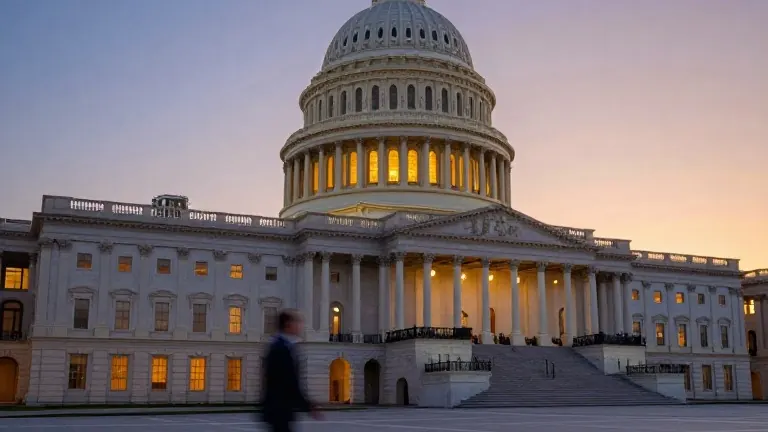
Democrats seized control of both the House of Representatives and the Senate in Tuesday's midterm elections, ending the Republican majority that had held both chambers. The outcome represents the largest gain for Democrats since the 1990s and signals a sharp rebuke to President Donald Trump's party.
According to Associated Press tallies, Democrats have won 228 House seats and lead in 34 others. This trajectory positions them to secure more than 260 seats, a level of strength not seen since 1990. In the Senate, Democrats have taken 54 seats and lead in one, crossing the 51-seat threshold required for a majority. Republicans currently hold 44 Senate seats and lead in one. The last time Democrats held such a clear Senate majority was in 2008.
The shift in power extends to the governorships of the 50 states. Democrats now control 28 governor's offices, while Republicans hold 20. Two races remain uncalled. Prior to these elections, Republicans held a majority of 27 governorships against 23 Democrats.
Several candidates made history during the voting cycle. Abdul El-Sayed, a former public health official, defeated Mike Rogers in Michigan to become the first Muslim elected to the US Senate. Trump had previously called El-Sayed a jihadist during a campaign rally in the state. El-Sayed told supporters that America's greatness requires the courage to correct its flaws.
In Illinois, Democrat Juliana Stratton won a Senate seat, joining Lisa Blunt Rochester of Delaware and Angela Alsobrooks of Maryland to form the first three Black women serving in the Senate simultaneously. In Georgia, former Atlanta mayor Keisha Lance Bottoms became the first Black woman elected governor in the United States. She defeated Republican Rick Jackson, who spent over $200 million of his personal fortune in the race.
Deb Haaland, a former US interior secretary and member of the Laguna Pueblo, won the New Mexico governorship, becoming the first Native American woman to hold the office. In Kansas, Democrat Adam Hamilton defeated incumbent Republican Senator Roger Marshall. Hamilton's victory marks the first time a Democrat has won a Senate seat in Kansas since 1932. He described the race as an effort to save democracy.
James Talarico defeated Texas Attorney General Ken Paxton in the state's Senate race, the first time a Democrat has won statewide office in Texas since 1994. Talarico, a member of the Texas House of Representatives, centered his campaign on opposition to billionaire influence in politics. He told a crowd in Austin that the people of Texas were his slingshot and that they had defeated Goliath.
Xavier Becerra won the California governor's race, becoming the first Latino to hold the office in a state where 40 percent of the population is Hispanic or Latino. He succeeded Gavin Newsom and pledged a fight against those who would come after California.
President Trump, whose name was not on the ballot, had urged voters to imagine it was. He endorsed several candidates who were defeated, including Darline Graham in South Carolina, Michael Whatley in North Carolina, and Mike Rogers in Michigan. Speaking to Fox News, Trump said the Democrats fought hard and acknowledged a mood in the air. He stated that he should not feel guilty about the results.
Voter turnout reflected a desire for change, with polls accurately predicting the Democratic sweep. Gary Colbert, a voter in Detroit, cited fuel prices and the US-Israel war on Iran as key factors. His wife, Shirley Colbert, noted the need for changes to address the cost-of-living crisis. She said she was voting for the Democrats because she was tired of the current administration.