Banyu Carbon Tests Sun-Powered Dye System in Western Australia
A Seattle company is demonstrating a direct air capture method that uses photoactive dyes to remove carbon dioxide without external heat sources.
By Grace Sullivan ·
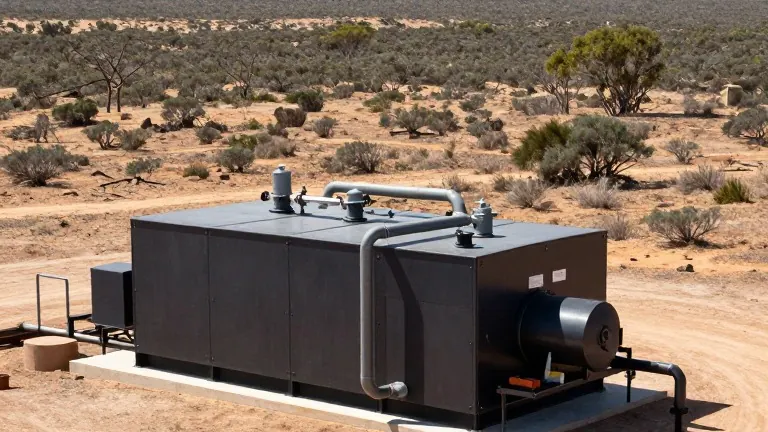
Alex Gagnon and Julian Sachs have installed a carbon capture unit in Western Australia to test a technology that uses dye and sunlight to pull carbon dioxide from the air. The Seattle-based company, Banyu Carbon, is conducting the trial at a testing site just south of Perth. Gagnon, an associate professor at the University of Washington, stated that their method is the only process that relies on sunlight-driven carbon dioxide removal.
The technology stems from research conducted ten years ago on Tetiaroa Island, a Pacific atoll formerly owned by actor Marlon Brando. While studying the effects of ocean acidification on coral reefs, Gagnon and Sachs focused on efficiently moving carbon between deep and shallow seawater. They utilized photoacids, which are light-sensitive molecules that can absorb and release carbon dioxide. This research built on a 2013 study by the Australian Commonwealth Scientific and Industrial Research Organisation, known as CSIRO.
Banyu Carbon secured an exclusive license to these photoacids a decade later. The University of Washington team spent three years refining the chemistry to allow for commercial scale air capture. The current demonstration unit operates by sucking air into a dark chamber where it contacts a water-based solution containing the dye. The solution absorbs carbon dioxide and then passes through panels exposed to sunlight. This exposure turns the dye acidic, causing it to release a concentrated stream of carbon dioxide for storage or industrial use.
Gagnon emphasized that the dye is reused repeatedly and the process does not require the heat or large energy plants needed by other direct air capture methods. He noted that the system only needs sunlight and air, eliminating the need for pipelines. The current demonstration model removes one ton of carbon over 12 months. For this trial, the captured carbon is re-released into the atmosphere to test the system's efficiency.
The company aims to scale up in the early 2030s to extract approximately 500,000 tons per facility per year at a cost of $200 per ton. Banyu Carbon has raised $8.5 million from investors and signed a $500,000 pre-purchase contract with buyers including H&M and Shopify. However, the broader carbon removal sector faces challenges. Climeworks, a major player with facilities in Iceland, cut 20% of its staff last year due to economic uncertainties.
Microsoft also reduced its investment in the sector this year, though a spokesperson said there was no change in long-term ambition. Carbon removal projects currently scrub about 2.2 billion tons of carbon from the air annually. Conventional methods like tree planting account for 99.9% of this total. Novel technologies remove only about 0.002 billion tons, with direct air capture representing a small fraction of that figure.
Mark Patel, a senior partner at McKinsey, identified financing as a major obstacle. He stated that lenders need clearer signals that carbon removal products have market value. Giana Amador, executive director of the Carbon Removal Alliance, said the sector is in its messy middle era. She noted that while companies can emit pollution for free, the market for removal must be created from scratch, making demand the greatest existential threat to the field.
Gagnon acknowledged that reducing emissions remains the primary goal for the planet. He said the best carbon removal is not putting carbon dioxide into the atmosphere in the first place. However, with fossil fuel use continuing, he believes researchers must now focus on solutions to remove existing pollution.